Why are blended families so difficult?
The reality is, when you involve children, step-parents, and various histories, it will never be an easy ride. Allegiances are challenged, regulations conflict, and passions are stirred. With good intentions and love, many families in Thornhill likely fall into the vortex of miscommunication, conflict, or distance. That is why family therapy may become an effective tool impossible to ignore; It is a place to unspread the mess, reconsolidate the trust, and create a secure, connected home where they can live.
I am Anna Welch, a citizen of the USA who enjoys writing about families and relationships and those issues that people tend to gloss over. I hope to give you useful advice and realistic solutions, which would help you to tackle your family problems with self-assurance and self-knowledge.
In this blog, I shall give an overview of the most common issues blended families tackle in Thornhill, how family therapy is designed and implemented, and how you could get the right therapist to aid your process.
What Is Family Therapy in Thornhill?
Family therapy in Thornhill is a professional and systematic procedure to assist a family, particularly those who have a combination of different lives, traditions, and expectations. Neither is it about blaming any finger nor who is right or wrong. It is a safe and neutral space where all members of your family are listened to. A trained therapist goes through sessions with you and your loved ones to help out with the unseen roots of conflict, improve communication, and develop effective day-to-day strategies.
Counselling in Thornhill is phenomenal since it is influenced by the diversity of the community. These families were varied in cultures, religion, and social backgrounds. The therapists at Thornhill know these layers and will structure their work to ensure your family does not feel criticized. Not only can therapy instruct you on how to handle it, but it also helps you learn how to have more trust, healthy boundaries, and behaviors that align with your family values and lifestyle.
Read Also: 7 Qualities Of A Healthy Relationship
Who This Guide Is For
This guide applies to you in case you live in Thornhill and cope with the reality of a blended family. Perhaps you have just remarried and are re-learning how to be a step-parent. Or perhaps your children are just flinging themselves between two households, torn between their bio-parents and step-parents. If any of that resonates with you, this blog is addressed to you.
It’s also for you if:
- You are a biological parent serving to maintain a relationship with a child, and also allow a new partner.
- You are a step-parent who wants to have a connection but feels uncertain of where boundaries are.
- You are a teenager or a child in a blended family, and you feel caught between expectations.
- You are co-parenting with the former spouse and find it difficult to make communication non-aggressive and take care of the children at the same time.
- You live in a culturally diverse family in Thornhill, and traditions and values may not always coincide.
Blended Families Common Pain Points
Blended families are great, but at the same time, there are special difficulties.
The Major Difficulties You Can Identify
- Conflicting loyalties: Children between blood and step-parents.
- Rule conflicts: Step-parents and biological parents have conflicts regarding rules.
- Role incongruity: Children are uncertain about how to treat a step-parent as either a friend or an authority figure.
- Unresolved grief: Children working through divorce, separation, or loss as they adapt to new terms.
- Co-parenting tension: Anti-partner tensions that carry over to the new facilities.
- Cultural or religious conflicts: Conflict in cultures or values within a family.
And so if this rings true to you, you are not alone. These are exactly the reasons why many families in Thornhill seek family therapy for blended family dynamics.
Check Also: How Well Do You Know Your Partner?
The Goal of Family Therapy
When I reflect on the treatment of blended families, I think of developing a secure environment where all voices count.
Core Goals of Therapy
- Better communication should eliminate misunderstanding spirals.
- Be clear in exposing duties so they are not mixed up and cause resentment.
- Enhance confidence between step-parents, children, and ex-partners.
- Discover how to disagree without belittling oneself through conflict resolution skills.
- Bring harmony, but not destroying individuality
- Support long-term stability by creating tools you can use daily.
Therapy isn’t to be healed. It’s about to provide you support in building a solid, supportive base for your Thornhill blended family.
Read Also: Free Dating For Disabled People
Evidence-Based Approaches You May Encounter

Family therapists in Thornhill don’t just wing it; they use tested, structured methods.
Approaches You Might See
- Structural Family Therapy (SFT): Maps out roles and hierarchies.
- Narrative Therapy: Assists every member to rewrite his or her personal narrative.
- Emotionally Focused Therapy (EFT): Ensures an emotional connection.
- Cognitive-Behavioral Therapy (CBT): Challenges the negative thinking styles.
- System Therapy: Believes that the family is a system, and not a collection of individuals.
All these procedures are adjusted to your family, but therapists tend to combine all their methods and do not stick to one.
Read Also: Is Marriage Counseling Covered By TRICARE?
How Therapy Usually Works: Step-by-Step
When we think of family therapy, the question begs to be asked: What actually occurs when we enter that office? Therapy in blended families is not about making a circle and a stranger telling you all that you are doing wrong. Rather, it is a process that follows systematic development. This is how it tends to go in Thornhill.
Read Also: Premarital Counseling Christian
Step 1: Check-in and Safety During Equality
The first session is all about listening and establishing the set of rules. The therapist meets you, your partner, your children, and sometimes even co-parents if that’s appropriate. Each gets the opportunity to explain his or her turning point.
- The therapist clarifies confidentiality to reassure you sure your own words are secure.
- Enquiring about immediate safety issues, such as feeling unsafe at home, emotionally, or physically.
- They attempt to know what each family member wants to improve.
This stage feels like opening a new chapter. It’s less about solving and more about understanding where your family is starting from.
Step 2: Map the Family System
Next, the therapist begins to sketch the “family map.” This is not a literal drawing, but how the relationship in your household is linked.
- With whom does one talk and how frequently?
- Where do conflicts usually flare up?
- Are there “alliances,” like a child siding with one parent against another?
This mapping assists the therapist (and you) to gaze the patterns behind the problems. In another example, perhaps one of the causes of conflict is that discipline is never uniform across parents. Noticing this clearly promotes a change.
Step 3: Set a Shared Vision
When the charts are clear, the therapist helps your family to make a common vision. This will be necessary because it will help avoid making therapy unilateral.
- Every one of them says what they want: to be less at war at home, less fighting, to be respected and closer to each other.
- The therapist then lumps these together and comes up with common goals that all can accept.
As an example, a child might desire more fun and less yelling, whereas the parent may desire better routines. The vision could be collective: “We will make our procedures easier so we can spend more fun time together.”
Step 4: Clarify the Duties & the House Rules
This is one of the crucial actions regarding blended families. Children need to understand expectations and who is in charge. In its absence, resentment accumulates fast.
- Parents and step-parents agree on definite house rules.
- Roles are established: disciplser, nurturer, decision maker.
- Children are informed about what is expected of them in a manner they can understand.
Another instance, instead of saying your step-dad is in charge, now, it is more appropriate to say, we make the same rules, and we can talk about a big change.
Step 5: Align Discipline & Routines

Blended Families frequently collide when children hear different rules in different places. Therapy brings discipline and routine into line.
- Parents are in unison with their modes of discipline (time-outs, grounding, rewards).
- Routines such as bedtimes, chores, and homework are explained.
- Children feel safe and aren’t able to set parents against one another because of this homogeneity.
A therapist may propose a family calendar, where every family member can undertake to know what to expect, regardless of the house they are in.
Step 6: Co-Parenting With Ex-Partners
This is usually the most difficult part of music. Even when you and your partner agree, friction with former spouses might be stressful to the children.
- The therapy promotes healthy, professional communication with other ex-partners.
- The focus stays on the child’s needs, not old conflicts.
- Strategies like shared digital calendars or parenting apps are often introduced.
The aim will be to lessen the child’s load. They cannot feel like messengers or spies between parents.
Read Also: How to Deal With Infidelity Guilt
Step 7: Construct Relationship And Ritual
Therapy is not only about politics, but also about delight. A blended family has to act as a family, not a group of individuals existing together in a home.
- Therapists promote the establishment of family norms, such as weekly pizza, games, or walks.
- Small rituals make children feel safe and bonded.
- There is also a decrease in tension since such rituals add fun to it all.
Building trust takes time, but rituals help the process along in a natural manner.
Step 8: Communication And Conflict Skills
Every family argues. Therapy helps you argue better.
- You’ll practice active listening, repeating back what you heard before responding.
- You’ll learn “I statements” instead of accusations. Such as, “When the chores are not done, I feel ignored” instead of, “You are lazy.”
- The therapist can enact conflicts so that you get to practice resolving them in a non-defensive manner.
The best thing about these skills is that they not only address today, but they also provide your family with tools to face the future.
Step 9: Protect Attachments And Resolve Loyalty Binds
Divided loyalty is one of the most difficult topics in blended families. A child might also feel guilty over fancying their step-parent as they believe that it is unfaithful to their parent.
- Therapists assist the children in learning that love is not a contest.
- Step-parents work out the way to connect gradually, not pressing too much.
- Children are reassured by their parents that it is acceptable to love both their biological and stepparents.
This step safeguards emotional attachments and ensures that no child is cornered.
Step 10: Measure Progress & Taper
Finally, therapy isn’t forever. Once your family starts thriving, sessions taper off.
- Development is monitored, reduced fights, better connections, and easier rituals.
- The therapist tapers sessions to allow you to practice using skills on your own.
- Families go home with skills that they can apply years later.
And the end is not treatment addiction, but the enabling of your family to move beyond with certainty.
Check Also: Is Your Relationship Toxic or Healthy?
Age-Specific Tips
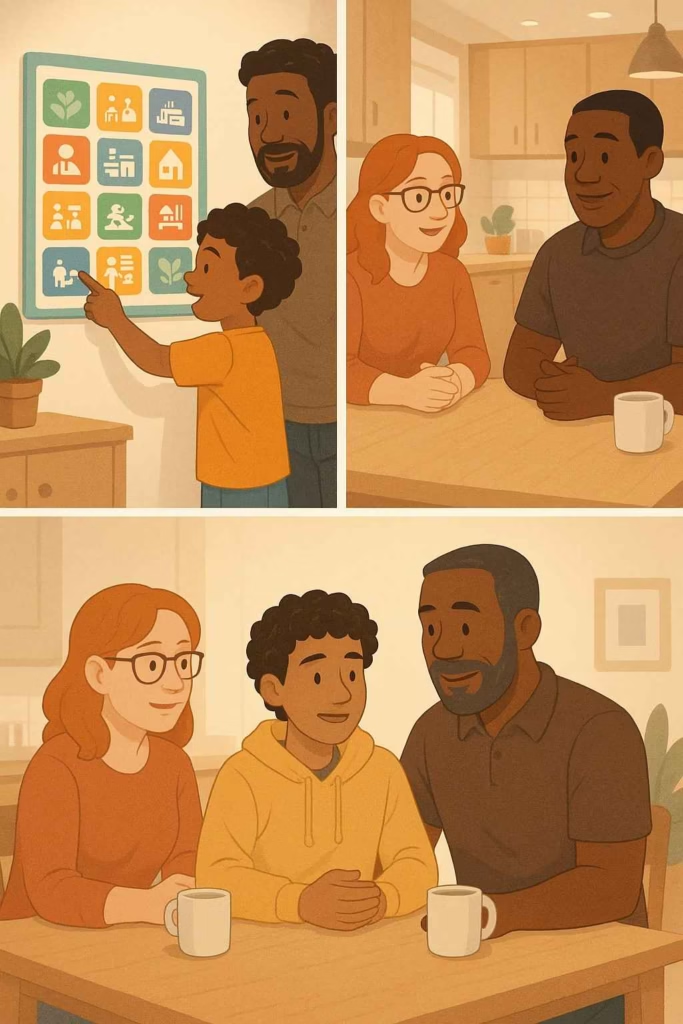
Younger Children
- Need consistency in routines.
- Benefit from visual schedules.
- Require reassurance that they are loved by all parents.
Teenagers
- Need more autonomy but still crave stability.
- Often resist authority from step-parents.
- Benefit from open discussions and negotiated boundaries.
Adult Children
- May still struggle with divided loyalties.
- Therapy can help maintain respectful extended-family relationships.
Cultural & Faith Sensitivity in Thornhill
Thornhill is greatly diversified with Jewish, Christian, Muslim, South Asians, and East Asians. That diversity shapes family life.
Therapists in Thornhill often:
- Respect religious traditions in family practices.
- Identify traditional ideals of parenting and respect between each other.
- Adapt the therapy techniques to suit family values, rather than against them.
What is crucial is that the blended family dynamics not only concern the relationships but also the culture, heritage, and faith.
How to Select a Family Therapist in Thornhill
It is as important to find the right therapist as it is to engage in therapy.
What to Look For
- Expertise on blended families: not every therapist is excellent in this sector.
- Cultural competence: Capacity to work with varied training in Thornhill.
- Good communication style: You must feel understood and heard.
- Practical tools: We do not just give theories, but ideas on how to do it at home.
- Availability: Place, affordability, insurance covers, or virtuality.
Read Also: What Happens If You Divorce a Disabled Spouse?
FAQs:
Is family therapy done only on serious issues?
No. It assists with communication, ordinary parenting problems, and life changes, not just a serious conflict.
Can children join the sessions?
Yes. Children and adolescents are normally involved since their voices count in solving family problems.
How do I find my family needs therapy?
In case of repeated conflicts, blocked communication, or stress in relationships, treatment can help.
Is therapy confidential?
Yes. Therapists are bound by stringent rules of confidentiality unless there is a safety issue.
Final Words:
Family therapy in Thornhill is not a finger-pointing or score-keeping activity. It is about the understanding that there is no perfect family, and it is okay. It is about the desire to grow together, listen when it feels better to close your ears, and develop much healthier means to bond when life situations attempt to yank you apart. Therapy is a safe place where everyone lends his or her voice. It can assist families in moving their conflict to a more profound level and learn the patterns, emotions, and needs that are often underlying the conflict.
Communication barriers, families struggling, stressed out, and overwhelmed, or wanting to strengthen your connection, therapy can help your family to gain new tools and strategies that can remain out of the therapy room for a long time.